Who we are, who serves, and the world we are organizing for.
The Stewardship Party is a return to stewardship in our daily lives, our institutions, and our government — rooted in service to neighbor, care for soil, and the unalienable rights affirmed by our Declaration of Independence.
The principles are not ours. They are older than any party and belong to no single age or nation. Stewardship is the fundamental tenet of every major faith and culture: that what you have been given, you are responsible for — and that you are meant to hand it on better than you found it. We did not invent that idea. We are simply organizing around it.
The party grew out of Food Forest Abundance, the permaculture movement founded by Jim Gale that has helped families across the country and beyond turn lawns into food forests. What worked on a quarter-acre turned out to scale. A permaculture farmer does not force chemicals and debt onto the soil; he aligns with its own regenerative wisdom, so the land improves year after year and asks for less. That is the model of government we are after.
We are funded entirely by small contributions from individuals. We accept no corporate money, no PAC money, and no foreign money. We are a movement in formation — if you do not yet see a chapter near you, you may be the one who starts it.
Every leader is a steward — or they are nothing.
Officers of the party. Every one of them was doing this work before there was a party to do it in.

Jim GaleFounder & Chair
Jim founded The Stewardship Party after a career that carried him through thirty-seven countries and into the eco-villages of Costa Rica, where he first saw what permaculture could do for a piece of land and for the people living on it. He went on to found Food Forest Abundance, and has spent the years since teaching anyone who will listen that a lawn is a wasted opportunity. He serves the party without salary. Read his story →

Randy L. IrelandVice Chair of Operations
Randy keeps the party's books. He began in the United States Air Force as an electrical power production technician — the person who keeps the power on so that everything else can run — and spent the decades after building the systems that institutions depend on, first with Lucent Technologies and then with the technology services firm he founded and ran in Connecticut. He brings that same discipline to a party funded entirely by small individual contributions: careful books, honest records, every dollar accounted for.

Nathan MartinSecretary
Nathan is a Logocentric philosopher who created an integrative methodology — the Unity Process — that draws from multiple domains and disciplines to help people process emotional upsets, heal trauma, discover meaning, set boundaries, and refine viewpoints.

Ben MissimerVice Chair of Permaculture & Design
Ben is a Navy veteran and certified permaculture designer who reads land the way he once maintained precision instruments — with GIS, LiDAR, and drone surveys — and turns raw acreage into a design a family can plant.

Dane PetersonVice Chair of Coalition Building
Dane has spent more than fifteen years helping people say yes to things that serve them. He carries the movement's message outward the way it spreads best — plainly, person to person.
Reach any of us directly — contact the party →
Those are the stewards. What follows is the world they are working toward — and the reason any of this is worth doing.
Not a metaphor. A picture you can stand in. Look at what stewardship makes possible in every place a human being lives, learns, works, and gathers.
Imagine each of these as you would imagine a memory you have not yet lived. They are not someday-things — they are already happening, somewhere, today.
A child walks barefoot through their own front yard and pulls breakfast from a tree. The lawn is gone. The chemicals are gone. The grocery bill is smaller. The neighbors stop to talk over the fence about what's ripe this week.
Children learn biology from the seed and the worm. Math from rows and yields. Patience from waiting for the tree to fruit. Anxiety drops. Attention rises. Lunch is what they grew this morning.
The lawn surrounding the sanctuary is a community food forest. The harvest feeds the food pantry. The garden feeds the youth program. Faith and food are remembered as one thing — as they always were.
Markets on Saturday. Music on weeknights. Front porches that face one another. Children who can walk to a friend's house. Elders who are known by name. Loneliness, the way we knew it, fades.
Hands in the soil are hands that build, not hands that break. Garden-based rehabilitation cuts recidivism by half. A man learns to grow food, and the man comes home a father, not a number.
Raised beds the height of a wheelchair. Tomatoes a grandmother can pinch. Mood scores up forty to sixty percent, falls down by half, medication use down by a third. Dignity comes home.
You cannot starve a people who can feed themselves. You cannot frighten a people who know their neighbors. Stewardship is the fundamental tenet of every major faith and culture — the one thing we can agree on, and the ground from which abundance is built. Bread before bombs. Soil before steel.
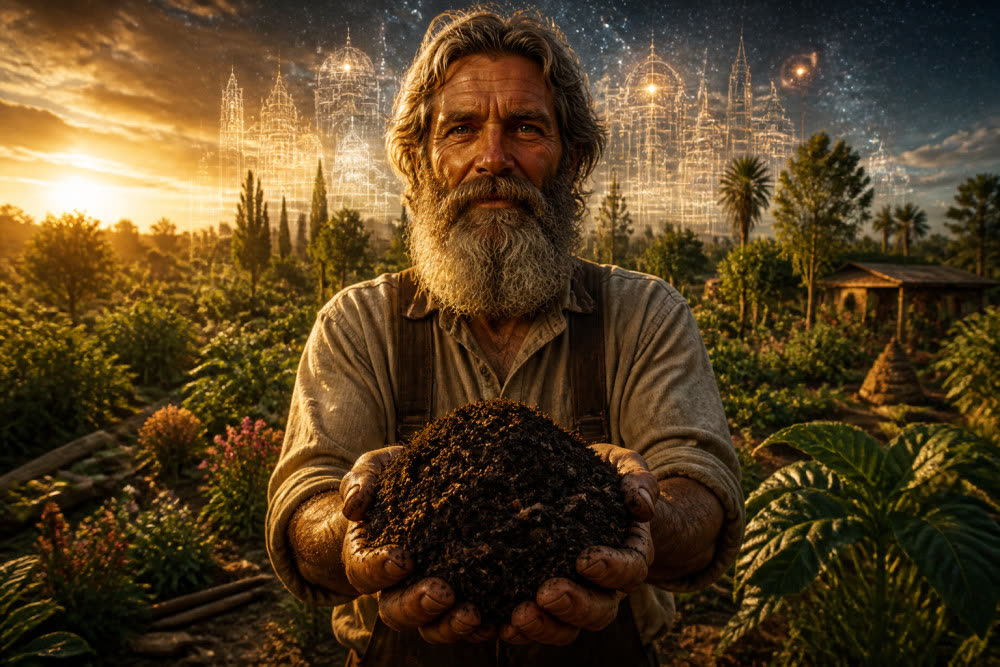
Sovereign heart, golden hands.
Every seed we sow, a Midas touch making the garden grow. Set to music — the vision you just read, sung.
This is what we are organizing for. Not a slogan. Not a someday. A place that already exists in pieces, waiting for us to connect them.

