America is in the middle of the largest social, loneliness, and mental health crisis of its modern history — and almost no one running for office is willing to call it what it is. We will. And we will offer a remedy older than any of the systems that produced it: the town square.
These are not three problems. They are one problem, viewed from three angles.
The U.S. Surgeon General has declared loneliness a public health emergency. Roughly half of American adults report measurable loneliness; among young adults the figure is higher. The mortality risk is comparable to smoking fifteen cigarettes a day.
Anxiety, depression, and suicide are at generational highs. One in five adults reports a mental illness in a given year. Teen depression has roughly doubled in a decade. The prescriptions are rising; the people are not better.
Civic clubs, fraternal orders, churches, bowling leagues, neighborhood associations — the connective tissue of American life — have hollowed out across two generations. People have screens. They do not have each other.
You cannot pharmaceutical your way out of a problem whose root cause is the absence of other people. You cannot algorithm your way back to belonging. The crisis is not first a medical crisis — it is a civilizational one. The medical bills are the receipt.
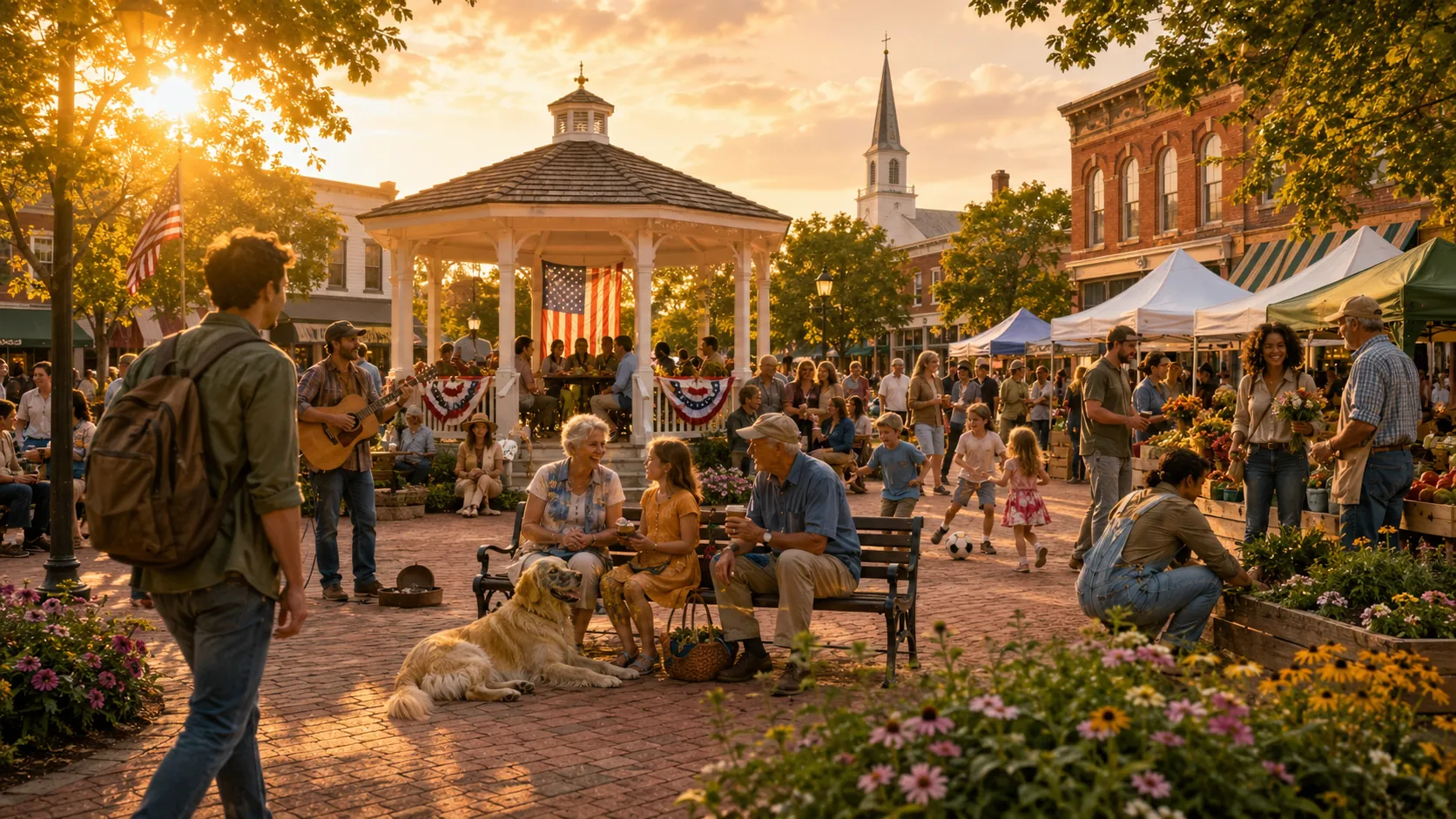
Every culture in human history has had a town square — a place where the day's work, the day's news, and the day's neighbors met. America had one too. We let it disappear. We can put it back.
The Stewardship Party Town Square Revival is not a single program. It is a deliberate set of small, local, repeatable practices that knit a place back into a place. Every chapter takes up as many as it can carry, and the rest follows.
A regular farmers' market — even a small one — is the most efficient social infrastructure ever invented. People come for the tomatoes; they leave with neighbors. We defend the markets we have and start new ones where we can.
Suburbs were designed to keep people inside. We design them, by neighborhood choice and small acts, to bring people back out — front-yard food forests, sidewalk benches, shared tool libraries, the small architecture of encounter.
A neighborhood that builds something together — a raised bed, a swale, a children's playhouse — discovers it can do other things together too. We host monthly work days at every chapter, with coffee, with kids welcome, with no agenda but the soil.
Seasonal celebrations tied to the harvest, the planting, and the shared calendar of a place. A potluck under a fruit tree does more for community mental health than any app.
A coffee shop, a library, a church hall, a public garden — somewhere that is not home and not work, where a person can simply be, and be greeted. We map them, support them, and protect them in every town.
Loneliness is heaviest on the very old and the very young — and they are the cure for each other. Stewardship chapters formally pair seniors with teens for practical skills and patient company.

None of this is exotic. None of it requires a federal program. It requires that a few neighbors decide together to begin — and a movement willing to back them, town by town, until what was lost is simply ordinary again.

